
DGV10 F4 Resilient Seated Gate Valve : Sealing Technologies in Industrial Flow Control
DGV10 F4 Resilient Seated Gate Valve : Sealing Technologies in Industrial Flow Control
Let’s explore the sealing technologies in industrial flow control together; operating deep within industrial facilities or inside the massive water networks beneath our cities, there are heroes that often go unnoticed but perform a vital mission. Known generally in the industry as gate valves, these pieces of equipment represent much more than a simple on-off apparatus.
Especially in modern infrastructure projects, the DGV10 F4 Resilient Seated Gate Valve, which has become a global standard, requires a rigorous engineering discipline at every stage—from material science to coating technology. At Devinsan, we work to ensure that these valves are not just a pile of metal in our production and export processes, but a symbol of trust that will provide years of trouble-free service. So, what are the invisible details that make a valve truly high-quality?
The Flexible Power of Ductile Iron
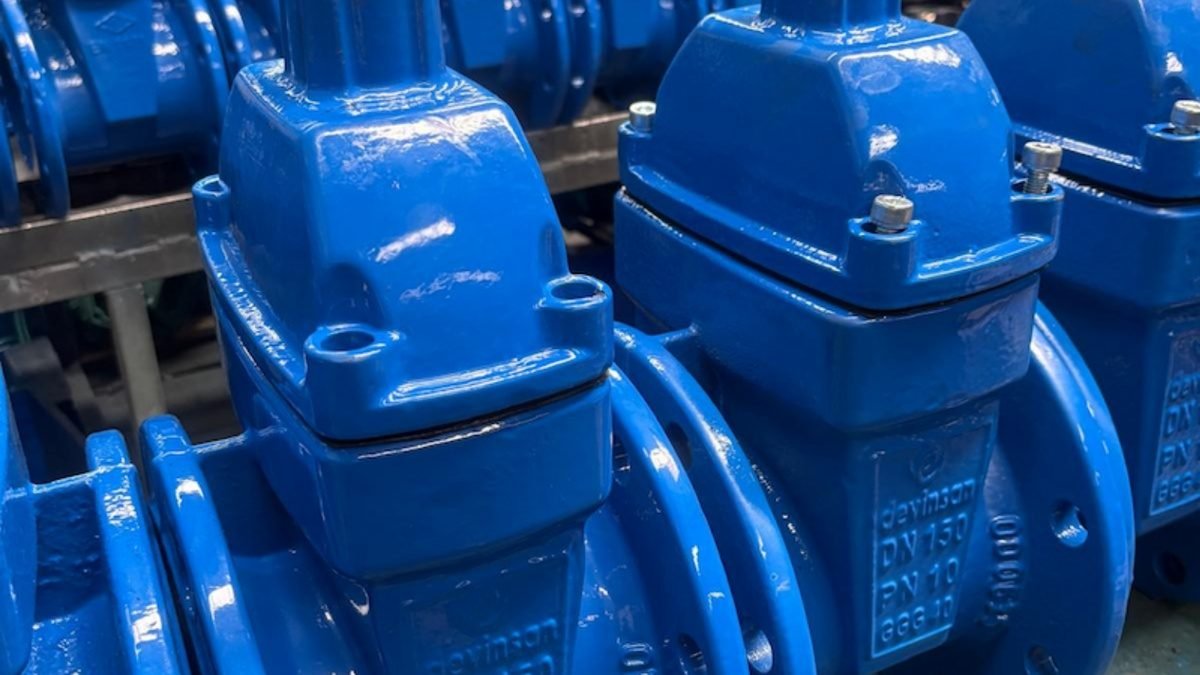
Everything begins in the foundry. The skeleton, or body, of the DGV10 F4 Resilient Seated Gate Valve is the first line of defense against the external factors it will encounter. Cast iron, which was widely used in the past, could crack like glass under sudden underground tremors or high-pressure shocks due to its brittle structure. Today, however, Ductile Iron GGG40 or GGG50, which sets our standards, provides the metal with a sort of “flexibility” thanks to the spherical structure of the graphite within it.
This characteristic means that the DGV10 F4 Resilient Seated Gate Valve responds with steel-like resistance to underground soil loads, dynamic vibrations from heavy vehicle traffic, and sudden pressure fluctuations—known as water hammer—within the pipeline. The internal design of the body is hydraulically optimized to allow water to pass smoothly without getting caught on any obstacles or creating turbulence. This smoothness is a hidden factor that increases overall system efficiency while reducing pumping costs.
The Ultimate Solution Against Corrosion: Electrostatic Powder Epoxy
The biggest enemy determining the lifespan of a valve is corrosion. A valve operates either in a damp valve chamber or directly underground, amidst aggressive chemicals and moisture. This is where the Electrostatic Powder Epoxy coating technology comes into play, providing the high durability we demand for the DGV10 F4 Resilient Seated Gate Valve. This is not just a painting process; it is a molecular-level union of metal and polymer.
The DGV10 F4 Resilient Seated Gate Valve body is first purified of all impurities through a precise sandblasting process. Then, electrostatic powder epoxy particles, charged with an electrostatic load, are sprayed onto the valve body. Due to the principle of opposites attracting, these powders adhere perfectly to the remotest corners of the body, stem housings, and flange surfaces.
This coating, cured in high-temperature ovens, wraps the valve like a glass armor with a minimum thickness of 250 microns. This smooth surface prevents lime buildup and does not allow bacterial growth in potable water lines. The quality of the epoxy is the most critical parameter determining whether the DGV10 F4 Resilient Seated Gate Valve will serve for 10 years or 50 years.
A New Era in Sealing: Resilient Wedge Technology
The heart of the gate valve is the vertical curtain that cuts the flow. In traditional metal-seated valves, sediment accumulation at the base of the valve was the biggest problem disrupting the seal. In the resilient seated design, this problem has been fundamentally solved. In the DGV10 F4 Resilient Seated Gate Valve series, the wedge body is completely encapsulated with EPDM rubber after being cast with total precision. This coating process is not a simple covering but a high-pressure vulcanization process. The rubber is integrated onto the metal in such a way that it does not separate or wear even after years of opening and closing cycles.
When the DGV10 F4 Resilient Seated Gate Valve is closed, this flexible wedge absorbs microscopic irregularities on the body surface like a gasket, ensuring a complete seal. The fact that the bottom of the valve is completely flat prevents sand and sediment in the fluid from accumulating there. Every time it opens, these particles are swept along the line by the power of the water; thus, the DGV10 F4 Resilient Seated Gate Valve maintains its “like new” full-closure performance every single time. This mechanism minimizes operating costs by extending maintenance intervals.
Engineering of the Stem and Sealing Elements
The stem, which provides the valve’s connection to the outside world, is under constant mechanical stress and the threat of corrosion. Therefore, the use of stainless steel in the production of the DGV10 F4 Resilient Seated Gate Valve is a non-negotiable standard. The multi-O-ring system used for stem sealing offers a much lower coefficient of friction compared to traditional stuffing boxes. This makes the valve easier to operate by reducing the torque required to open and close it, while also optimizing actuator costs.
Specifically, the Non-Rising Stem design is one of the greatest advantages of the DGV10 F4 Resilient Seated Gate Valve. When the handwheel is turned, the wedge moves inside the valve while the length of the stem remains constant. This means great comfort for installation teams working in confined spaces. Moreover, since the stem does not rise, it protects the stem from external dust, mud, or impacts, thereby extending the life of the mechanism. The ability to replace stem sealing elements even while the line is under pressure allows for maintenance without needing to stop the system.
Precision in the Field of Application
No matter how perfectly a DGV10 F4 Resilient Seated Gate Valve is manufactured technically, faulty applications in the field can waste all the effort. During installation, it is critical that the flanges are perfectly parallel to each other, bolts are tightened reciprocally with a torque wrench, and most importantly, the line is thoroughly flushed before installation. Welding burrs or construction debris inside the pipe are the only elements that can damage that sensitive EPDM wedge. A professional operator must ensure the line is clean before putting the valve in place. Correct installation is the most critical step to ensure the valve reaches its promised service life.
Building the Infrastructure of the Future
In conclusion, the DGV10 F4 Resilient Seated Gate Valve model is a complex engineering equation. At Devinsan, we meticulously follow every step—from the metallurgical analysis during the casting stage to the micron measurements of the Electrostatic Powder Epoxy coating. Because we know that a city’s water network or a factory’s fire line is only as strong as the quality of the smallest valve used.
Produced with the right material selection and the right engineering approach, these valves are the invisible but strongest guarantee of sustainable infrastructure projects of the future.
Discover other gate valve models in our product range. ➡️ Gate Valves
Contact Us